Contents: Planet Vulcan | The Afterlives of Scientific Ideas | About This Collection | Further Reading
Planet Vulcan
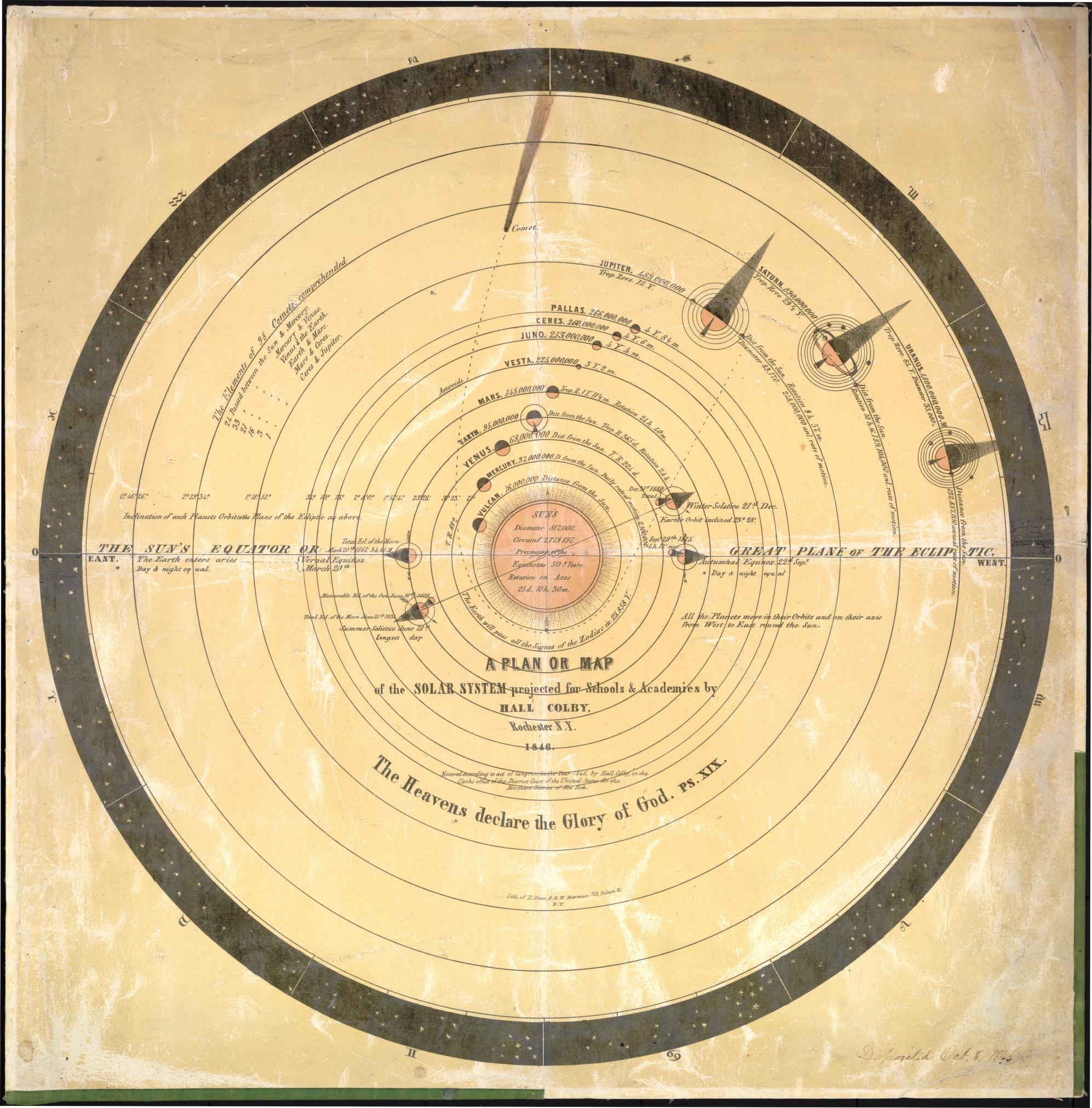
In 1846, the French astronomer Urbain Leverrier compiled data from the orbital irregularities of the planet Uranus to calculate an eighth planet. That planet was soon sighted within a degree of his estimate, and today we call it Neptune. Satisfied with his methods, Leverrier turned his attention to the orbit of Mercury, which his analysis proved was also disobeying Newtonian mechanics. In 1859 he announced his prediction of another planet between Mercury and the Sun.
Within the year, a French country physician and amateur astronomy named Edmond Modeste Lescarbault reported to Paris that he’d witnessed a dark spot traversing the sun. After inspecting the country doctor’s instruments, Leverrier declared the object was his predicted planet. This object was named Vulcan. Yet the size and motion of Lescarbault’s Vulcan didn’t complete the mathematical picture. Furthermore, Emmanuel Liais, a French astronomer working in Brazil in 1859, had been observing the sun at the same day and hour as Lescarbault and he’d witnessed nothing.
Despite widespread popular enthusiasm, the profession remained skeptical.
For decades to come, each eclipse brought out Vulcan-spotters with varying results. In the late 19th century, scientists were only beginning to theorize on sun spots and solar flares and to speculate on the chemical composition of astronomical bodies. This was also an era of intense and competitive hunting for asteroids, which at the time were known as minor planets. In 1878 one of these hunters, University of Michigan’s James Craig Watson, claimed to have spotted Vulcan. Lewis Swift in Rochester, New York, independently confirmed Watson’s claim. The enthusiasm was reignited for a short time.
During a 1919 eclipse, the British astronomers Frank Watson Dyson and Arthur Stanley Eddington found proof of general relativity: starlight was shown to bend under the effect of the sun’s gravity. Their observations were widely heralded for confirming Einstein’s work and for explaining the apparent irregularities of Mercury. The question settled, the scientific search for a new planet re-focused on the outer bounds of the solar system and eventually peaked with the discovery of Pluto in 1930.
The Afterlives of Scientific Ideas
The Vulcan saga is a prominent example of a very public claim-and-retraction cycle, and one that resurfaced periodically for half a century. Retractions are among the types of scientific information which highlight the problems of the “deficit model” of science communication: the belief that increasing access to information is sufficient to improve public attitudes toward science. Once science enters culture, its claims, conjectures, and personae operate as culture and form productive elements of identity and communication. Hypothesis, probability, and proof are operationally different in culture, and changes in fact and truth can find the public resistant or resentful.
This collection was organized under the philosophy that the science as culture has a place in the history of science and that both fields might benefit from cross-pollination. For the historians, topics such as the education of young scientists, the motivations of scientists, and the sourcing of funding and instruments all rely in part on the interests and perceptions of non-specialists. Outside of its own magic circle of practice and logic, science exists as metaphor, mythology, ideology, identity, curiosity, and need, which are each cultural and historical processes.
Vulcan, the planet that never was, takes on many guises in this library. It was modernity itself, and it was a Victorian mistake. It was the clash of empiricism and idealism. A mathematical marvel and a pernicious waste of effort. Vulcan was at once a symbol of hope, failure, and success. I invite you to consider these lenses as you peruse this digital library.
About This Collection
The author: Elizabeth-Marie Helms is a graduate student in Library Science and The History and Philosophy of Science and Medicine at Indiana University. A former middle school teacher, she currently researches the history of the public understanding of science.
The library: This digital library is built upon the CollectionBuilder framework. It began as a term project for John A. Walsh’s Digital Libraries course.
Except where indicated, the item images and texts in this collection are in the public domain within the United States. Items have been sourced from:
- America’s Historic Newspapers (Readex)
- Gallica (Bibliothèque nationale de France)
- HathiTrust
- The Library of Congress
Original descriptions and content pages of this library are released under a Creative Commons Attribution license. You are free to share, copy, and redistribute the material in any medium or format for any purpose, even commercially.
Further Reading
Baron, David. American Eclipse: A Nation’s Epic Race to Catch the Shadow of the Moon and Win the Glory of the World. Liveright, 2017.
Baum, Richard. In Search of Planet Vulcan: The Ghost in Newton’s Clockwork Universe. Plenum Press, 1997.
Brown, Kevin. “Vulcan’s Muddy Light.” University of Michigan Heritage Project, n.d. Accessed October 31, 2025. https://heritage.umich.edu/stories/vulcans-muddy-light/.
Hanson, Norwood Russell. “Leverrier: The Zenith and Nadir of Newtonian Mechanics.” Isis 52, no. 3 (1962): 359–78.
Levenson, Thomas. The Hunt for Vulcan: …And How Albert Einstein Destroyed a Planet, Discovered Relativity, and Deciphered the Universe. Random House, 2015.